Your Engineers Are 10x Faster Now. So Why Is Everything Still Stuck?
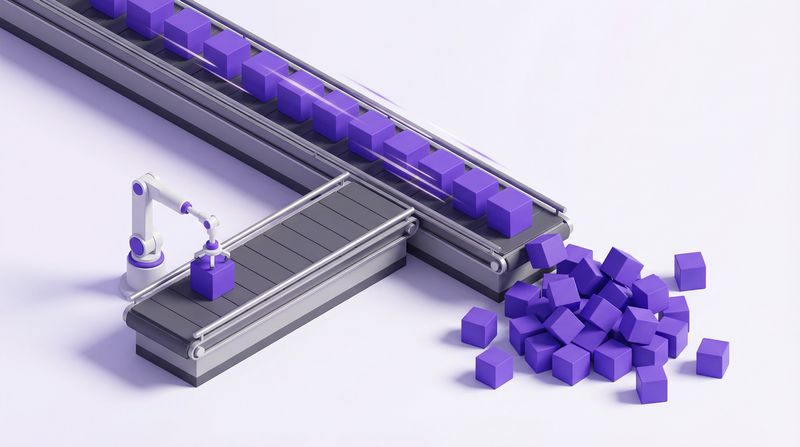
The real bottleneck in software development was never the code.
Something strange is happening in tech right now.
Companies are laying off engineers by the thousands — over 245,000 in 2025 alone. New software engineering job postings dropped 15% in early 2026. And yet, the remaining developers are shipping more than ever. AI coding tools have pushed individual output up by 40–55%. A team of ten now does what fifteen used to.
So everything should be running smoother, right?
It's not. And I keep seeing the same pattern when I work with companies on their processes.
The bottleneck moved. Nobody noticed.
For decades, the standard ratio in software teams was roughly six engineers to one product manager. The logic was simple — engineering was expensive and slow, so you needed more hands. Product management was about feeding the machine with requirements.
That logic just broke.
When a team can go from a rough idea to a working prototype in hours — not months — the constraint flips. The hard question is no longer "how do we build this?" It's "what exactly should we build, and why?"
I've watched this play out in real time. A company hires two developers and arms them with AI tools. Output goes through the roof. Three months later, they've built four internal tools. Nobody uses any of them. The developers did their job perfectly. The problem was upstream — nobody had clearly defined what actually needed solving.
The "what to build" problem is everywhere
This isn't a tech-company problem. I see it constantly in regular mid-sized businesses — 50 to 500 employees — that need software solutions but don't have the internal muscle to define what they actually need.
Here's the typical scenario:
A company decides they need a new tool — maybe a CRM, an internal workflow system, or an integration between two platforms. They find a dev team or buy a SaaS product. Six months later, nobody uses it. Not because the code was bad, but because nobody properly defined the problem it was supposed to solve.
The technology was never the bottleneck. The thinking was.
And now that AI has made building cheaper and faster than ever, this gap is only getting wider. You can spin up a prototype in a weekend. But if the prototype solves the wrong problem, speed just means you fail faster.
The roles nobody talks about
All the discourse right now focuses on developers. "Will AI replace programmers?" fills every tech feed. Meanwhile, almost nobody is asking the more important question:
Who decides what gets built?
In a traditional software team, that job was split across product managers, business analysts, and sometimes designers. Here's what's actually happening to those roles:
Product managers are shifting from coordinators to strategists. When AI can generate code from a spec, the spec becomes the most valuable artifact. The PM who can clearly articulate what to build and why — grounded in real user insights and business context — is suddenly the highest-leverage person in the room.
Business analysts are being squeezed from both sides. Junior BA work — gathering requirements, writing documentation, mapping as-is processes — is increasingly handled by AI. But the senior BA skillset — facilitating tough conversations, navigating stakeholder politics, framing the right problem to solve — is more valuable than ever. The gap between "replaceable" and "indispensable" in this role has never been wider.
The new shape of teams is smaller and flatter. Industry analysts predict that within five years, most organizations will move from large engineering departments to small, AI-augmented pods of 3–5 people: a product strategist, an AI-augmented engineer, QA, maybe a designer. That's it.
Before you automate, standardize
But there's a step that comes even before "define what to build" — and almost everyone skips it.
You can't automate a process that doesn't exist in a consistent form. And most company processes don't. The same task gets done three different ways depending on who's doing it. The same product is sold through different channels with different steps. Approvals follow whatever path the person involved happens to know.
I've walked through companies where the same order processing workflow had five variations — not because anyone designed it that way, but because five people figured out their own version over the years. You can't build a tool for that. You can't even write a spec for that. First, you need to standardize it into one clear process. Then you can decide whether to automate it, simplify it, or leave it alone.
This is the part that sounds boring but has the biggest impact. When you standardize a process — even before you touch any technology — you typically eliminate 20-30% of the waste just by removing redundant steps, unnecessary handoffs, and variations that exist for no reason.
And once a process is standardized, suddenly everything becomes possible. A simple integration can replace hours of manual work. An off-the-shelf tool fits because the process is clear enough to match. Even AI makes sense — because there's a consistent pattern to learn from.
Standardize → then decide what technology (if any) to apply. That sequence matters. Most companies do it backwards — they buy the tool first and try to force their messy processes into it.
The skill that actually matters now
If you zoom out, there's one skill that connects all of this: the ability to walk into a company, understand how things actually work, standardize the chaos, and then — and only then — define what needs to be built.
This isn't a new skill. Great process consultants, business analysts, and solution architects have always had it. But it used to be one input among many. Now it's the constraint.
AI gave everyone a printing press. But owning a printing press doesn't tell you what to print. The mechanical barrier is gone. What remains — and what matters more than ever — is the ability to figure out what's worth printing in the first place. And to make sure the text is ready before you hit print.
What this means if you're not in tech
Here's what most coverage misses: this shift doesn't just affect tech companies.
Every mid-sized business is now a software buyer, integrator, or builder — whether they realize it or not. They're choosing SaaS tools, commissioning custom integrations, automating workflows. And the cost of building or customizing these solutions is dropping fast.
But the cost of building the wrong thing hasn't dropped at all. If anything, it's gone up — because now you can build the wrong thing much faster and waste resources at scale.
What these companies need isn't more developers. It's someone who can walk through their operations, identify where they're bleeding time and money, figure out whether the solution is technology or a simple process change, and define exactly what needs to happen — before a single line of code gets written.
That role — part analyst, part strategist, part translator between business and technology — is becoming the scarcest and most valuable position in the entire software value chain.
The question nobody's asking
We're spending billions teaching people to code. Bootcamps, online courses, university programs — all focused on the building side.
Where's the equivalent investment in teaching people to define what needs to be built?
Where are the programs that teach structured problem discovery? Process analysis? The ability to sit in a room with a frustrated operations manager and figure out that their real problem isn't the software they think they need — it's three unnecessary steps in a workflow that nobody questioned for five years?
AI made the building easy. But the thinking — the messy, human, contextual work of understanding what's actually broken and what would actually fix it — that's still hard. And it's where the value is moving.
If you're in a position where you define problems, design solutions, and bridge the gap between business needs and technology — you're sitting on the right side of this shift.
If your organization is still structured around the assumption that engineering is the bottleneck — it might be time to look again.